


Almost half of the perennial springs in the Indian Himalayan Region have either dried up or become seasonal, according to assessments cited by the NITI Aayog. The decline is already affecting drinking water supplies in thousands of Himalayan villages.
Now, stakeholders working in the Darjeeling-Sikkim Himalayas are calling for a national policy framework that treats springs and their recharge areas as critical water infrastructure.
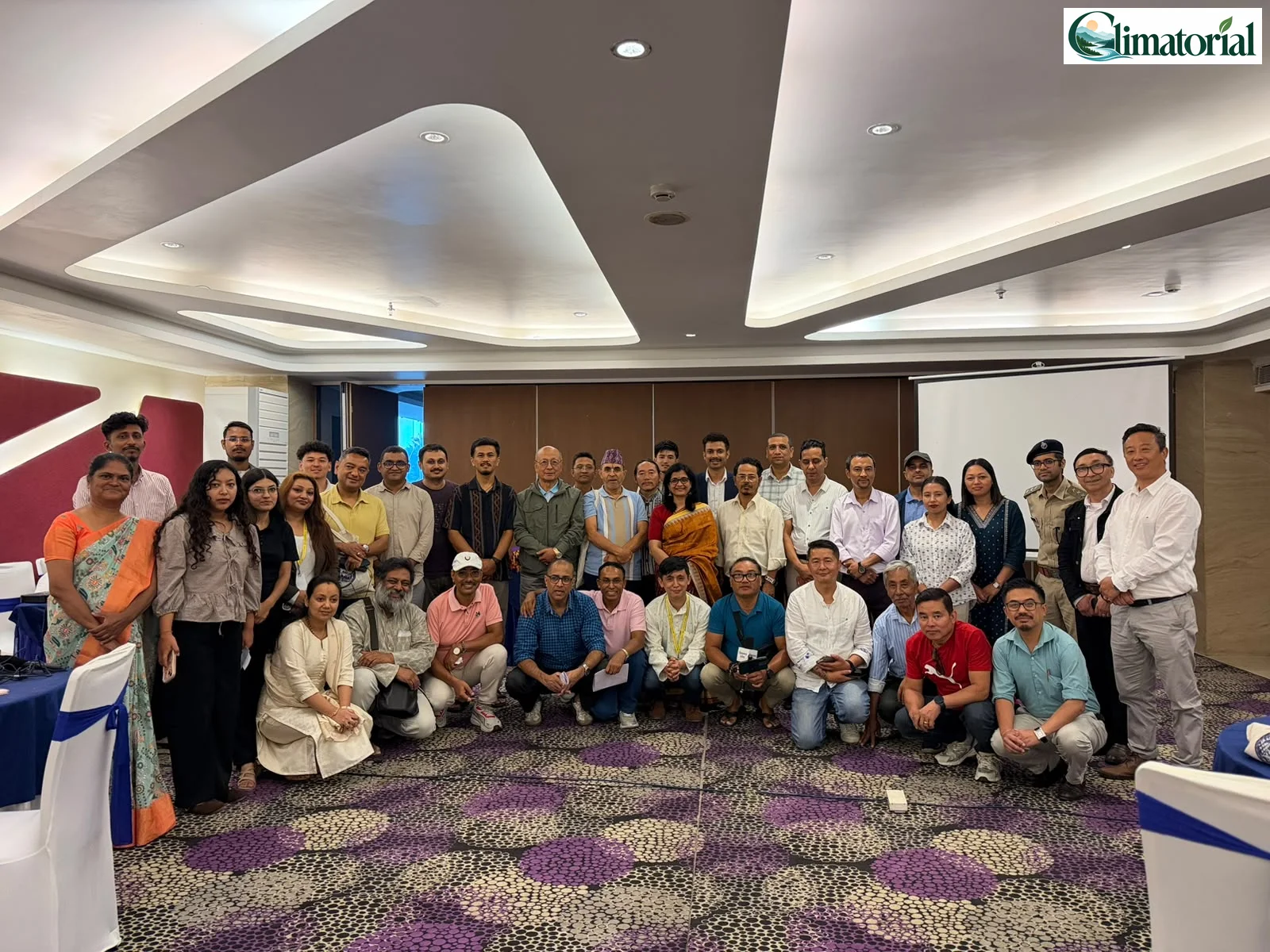
The demand emerged from a multi-stakeholder dialogue in Siliguri on October 3, organised by SaciWATERs and Heinrich Böll Stiftung. Forty-two participants representing 25 organisations, including government officials, public health engineering personnel, forest officials, researchers, civil society organisations, municipalities, tourism practitioners and media, discussed the region's growing water insecurity.
The meeting comes ahead of a policy dialogue on October 8 involving elected representatives and senior policymakers.
A crisis recognised years ago
India has known about the vulnerability of Himalayan springs for a long time.
NITI Aayog report says that increasing evidence shows springs were drying or experiencing reduced discharge across the Himalayas. It linked the pressure to multiple factors, including erratic rainfall, seismic activity and ecological degradation associated with land-use change and infrastructure development.
Department of Land Resources estimates that India has more than 5 million springs, from which nearly three million are in the Indian Himalayan Region. It says an estimated 200 million people depend on these spring waters across India's mountain ranges, including the Himalayas, Western Ghats, Eastern Ghats and Aravallis.
For the Himalayan Region specifically, NITI Aayog has described springs as the primary water source for more than 90% of rural communities.
That makes the loss of springs more than a local water-supply problem.
Rapid disappearance of spring water sources
In a recent seminar held in Siliguri, West Bengal, Dr Kabindra Sharma, Fellow at SaciWATERs, said that water security cannot be addressed through delivery infrastructure alone.
“Water security cannot be achieved through delivery infrastructure alone. It also requires scientific spring mapping, protection of recharge areas, appropriate rejuvenation measures and meaningful community participation,” Sharma said.
Springs also sustain agriculture, livelihoods and tourism and help maintain streams and river flows during the dry season. The Department of Land Resources notes that springs have an important hydrological role in sustaining dry-season flows in non-glaciated catchments.
This is particularly important in the Eastern Himalayas, where communities often live on steep terrain with limited alternatives for accessing groundwater or large surface-water sources.
Darjeeling illustrates the contradiction sharply. Despite receiving around 3,100 mm of annual rainfall, the hill city has experienced chronic water shortages. Research has found that its water supply is constrained by its geography, ageing infrastructure, population growth and increasing commercial demand associated with tourism. Darjeeling is largely dependent on a limited number of springs and other mountain water systems.
Sikkim as a spring revival case study
Sikkim's experience demonstrates that spring revival does not have to remain a theoretical policy proposal.
Sikkim's Dhara Vikas initiative was launched in 2008 to revive dying springs, lakes and streams. Around 80% of rural households in Sikkim depend on springs for drinking water and irrigation, according to a UNDP account of the programme. The initiative combines geohydrology, watershed management and GIS with traditional community knowledge.
At the Siliguri dialogue, Dr Ghanshyam Sharma of Sikkim said, "The importance of hydrogeological understanding, accurate identification of recharge zones and scientific techniques, including radioisotope studies of selected springs in the Pandam area".
Earlier implementation of Dhara Vikas had mapped hundreds of springs and treated recharge areas, demonstrating that spring revival can produce tangible results.
The question is whether such approaches can be scaled across the Himalayas—and who will pay for them.
Dr Subash Dhakal, Deputy Director, Land and Revenue, Government of Sikkim, said, "The need for dedicated funding and locally appropriate schemes to expand springshed management".
The policy gap
India has already developed guidance on springshed management.
In 2021, NITI Aayog released a resource book on springshed management after more than a decade of spring-revival experience across the Himalayan region. The document recommended the creation of a National Springs Mission to coordinate and scale up spring management, along with a national digital database of spring-related information and stronger science-policy-practice networks.
Yet spring governance remains dispersed across institutions and laws.
A 2025 mapping of the legal landscape found that Himalayan states and Union Territories use a patchwork of water, groundwater, forest, municipal, irrigation, building, hydropower and mining regulations to address springs. Ownership and governance can also vary between state, community and private systems.
The result is a governance problem: a spring may be a water source, a forest issue, a groundwater issue, a municipal concern and a community resource at the same time, but no single institution necessarily has responsibility for protecting the entire springshed.
Climate change is only part of the story
The drying of Himalayan springs is increasingly discussed through the lens of climate change, but the evidence points to a more complicated picture.
Changing rainfall patterns can affect groundwater recharge, but land-use change, construction, deforestation and other forms of ecological disturbance can also alter the aquifers feeding springs. NITI Aayog itself has identified both climatic and human-induced pressures.
Recent research from Darjeeling adds another layer. A 2026 study found that the city's water system is fragmented between a colonial-era municipal network, private water delivery and community-managed springs. It describes chronic scarcity despite the region's high rainfall and highlights the complex social and institutional dimensions of water access.
A separate 2026 study of a spring-rejuvenation project in the Darjeeling hills mapped 300 springs between 2019 and 2024 and reported measurable recovery in two rejuvenated sources, improving water access for about 200 households.
These examples suggest that the problem is not necessarily a lack of solutions. It is the lack of scale, coordination and long-term governance.
Who protects the spring?
Participants in Siliguri are calling for clearly defined institutional responsibilities, dedicated financing, stronger coordination between departments and the integration of springshed management into existing water programmes.
They are also asking that community-led conservation and Indigenous knowledge be recognised in formal planning.
The stakeholders estimate that springs are critical to the water security and livelihoods of around 50 million people across the Himalayan region.
The larger government estimates underline an even broader dependence on spring water across India's mountain regions.
For Darjeeling and Sikkim, the immediate challenge is therefore not simply finding more water.
It is protecting the landscapes that produce it.
India already has the science, state-level experience and policy recommendations to begin doing that. What remains unresolved is whether those pieces can be brought together into a system where someone is clearly responsible for keeping the Himalayas' natural water taps flowing.


 Continue With Google
Comments (0)